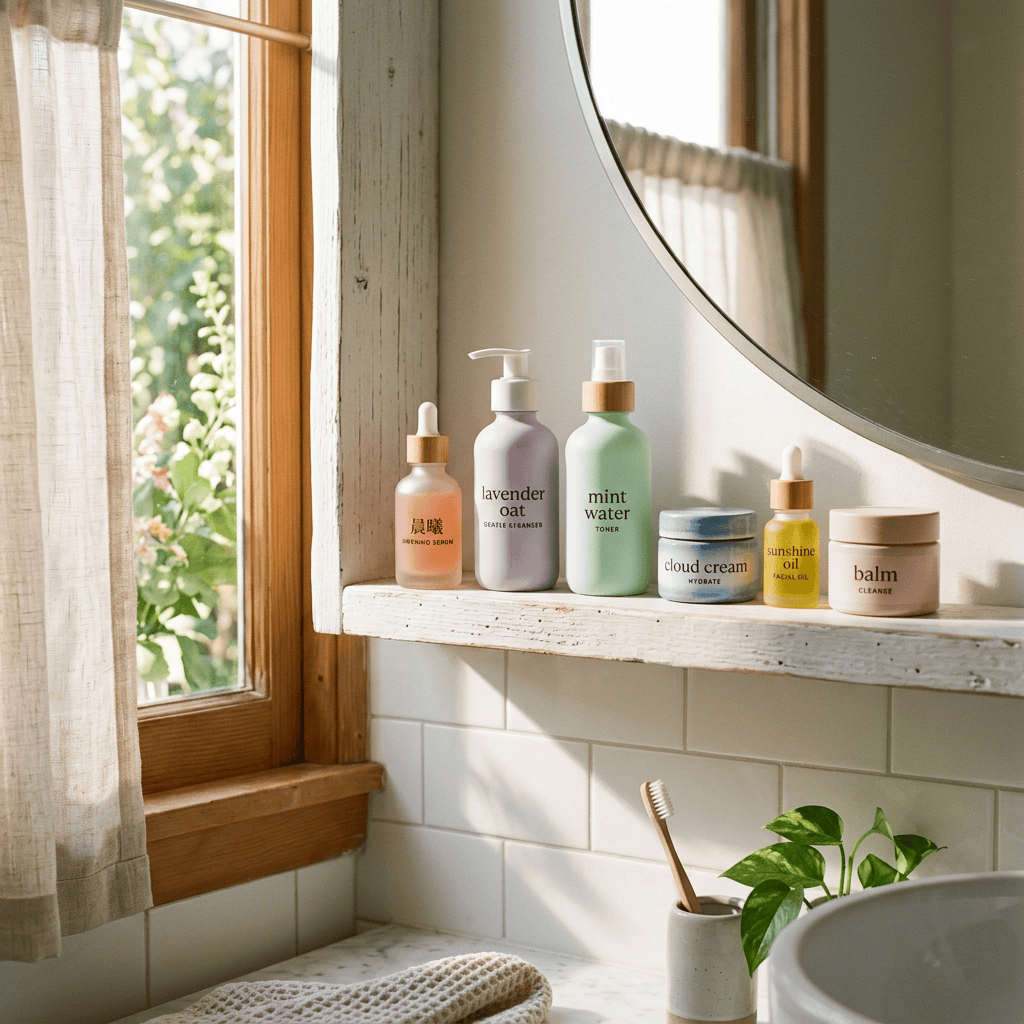
Turn over almost any skincare bottle and the ingredient list can feel like another language.
Alcohol. Fragrance. Parabens. Sulfates. Essential oils. Preservatives.
Then you search online and discover dozens of lists telling you:
“Never put these ingredients on your face.”
But skincare is rarely that simple.
The better question is not:
“Which ingredients are bad?”
It is:
“Which ingredients might be wrong for my skin?”


First: There Is No Universal “Bad Ingredient” List
An ingredient can be perfectly tolerable for one person and irritating for another.
What matters includes:
- concentration
- formulation
- frequency of use
- your skin type
- your current skin-barrier condition
This distinction is especially important in Korean skincare, where the goal should not be to build the longest possible blacklist.
The goal is to understand what your skin actually tolerates.
1. Fragrance: One of the First Things Sensitive Skin Should Question
Fragrance makes skincare more enjoyable to use, but it does not generally provide an essential skincare function.
For most people, that may not matter.
For reactive skin, however, fragrance can become an unnecessary variable.


You may want to prioritize fragrance-free products if you experience:
- frequent redness
- unexplained itching
- burning after skincare
- eczema-prone skin
- rosacea-prone skin
- repeated reactions to new products
And remember:
“Unscented” and “fragrance-free” do not necessarily mean exactly the same thing.
If sensitivity is your concern, inspect the ingredient list rather than relying entirely on the front label.
2. Essential Oils: Natural Does Not Automatically Mean Gentle
Lavender. Lemon. Bergamot. Peppermint. Eucalyptus.
They sound natural—and they are.
But natural does not mean non-irritating.


Essential oils contain numerous aromatic compounds, and some people with reactive skin may find them irritating or sensitizing.
That does not mean every person must avoid every essential oil.
But if your skin seems to “react to everything,” simplifying your routine by removing fragrance and essential oils is often a sensible experiment.
3. Sulfates: More Relevant in Cleansers Than Serums or Creams
Sodium lauryl sulfate (SLS) is an effective surfactant.
It cleans well.
Sometimes, however, it cleans too aggressively for a particular skin barrier.


If your cleanser leaves your face feeling:
- tight
- squeaky
- dry
- itchy
- uncomfortable immediately after washing
the cleansing system may simply be too aggressive for you.
This is particularly relevant for dry, sensitive, or barrier-damaged skin.
A cleanser does not need to leave your face feeling stripped to be effective.
4. Drying Alcohols: Look at the Entire Formula
“Alcohol” is one of the most misunderstood words in skincare.
Some alcohols can contribute to a lightweight, fast-drying texture. In certain formulations, that can be useful.
But high levels of volatile alcohols may feel uncomfortable on dry or reactive skin.
Common examples include:
- Alcohol Denat.
- Ethanol
- SD Alcohol
- Isopropyl Alcohol

6
But don’t confuse these with fatty alcohols such as:
- cetyl alcohol
- cetearyl alcohol
- stearyl alcohol
These function very differently and are commonly used as emollients and formulation aids.
So:
“Alcohol-free” is not automatically better, and “contains alcohol” is not automatically bad.
Context matters.
5. Strong Exfoliating Acids: The Ingredient May Be Fine—the Dose May Not Be
AHAs and BHAs are not inherently bad ingredients.
They can be extremely useful.
The problem begins when you use:
too much + too often + too many products.

Be particularly cautious with:
- glycolic acid
- lactic acid
- salicylic acid
- exfoliating peel solutions
especially when combined with other strong actives.
Signs that your exfoliation routine is too aggressive include:
- burning
- persistent tightness
- shiny but dehydrated-looking skin
- flaking
- sudden sensitivity
- products that previously felt fine suddenly sting
At that point, adding another “soothing serum” is rarely the answer.
Reduce the actives first.
6. Retinoids: Don’t Avoid Them—Respect Them
Retinol is another ingredient that frequently appears on “ingredients to avoid” lists.
That is overly simplistic.
Retinoids can be highly useful ingredients, but beginners often introduce them too aggressively.

Problems are more likely when you:
- start with a high concentration
- use it every night immediately
- combine it with aggressive exfoliation
- continue despite significant irritation
A better approach is:
low concentration → low frequency → gradual increase
You don’t need the strongest retinol.
You need the strongest retinol your skin can comfortably tolerate over time.
7. Too Many Actives May Be More Important Than Any Single Ingredient
Sometimes the problem isn’t one “bad” ingredient at all.
It’s the combination.
For example:
Morning:
- exfoliating toner
- vitamin C
- niacinamide serum
Evening:
- acid cleanser
- retinol
- exfoliating treatment
Each individual product may be reasonable.
Together?
Your skin may disagree.


This is one of the biggest mistakes beginners make with Korean skincare.
Because K-beauty encourages layering, it is easy to confuse:
layering hydration
with
layering actives.
They are not the same thing.
What About Parabens?
Parabens are frequently placed near the top of internet “toxic ingredient” lists.
But simply seeing methylparaben or propylparaben on an ingredient list does not mean a product is unsafe.
Preservatives serve an important purpose:
they help prevent microbial contamination.
A poorly preserved water-based cosmetic is not inherently safer because its label looks more “natural.”
For most consumers, parabens should therefore not be the first criterion used to reject an otherwise appropriate skincare product.
What About Chemical Sunscreen Filters?
This is another area where fear-based skincare advice becomes misleading.
Chemical—or more accurately, organic—UV filters are not automatically ingredients you should avoid.


Some people tolerate mineral filters better.
Others strongly prefer modern organic filters because they can provide:
- lighter textures
- less white cast
- comfortable daily wear
And daily sunscreen that you actually enjoy applying consistently is far more valuable than an allegedly “perfect” sunscreen that you hate wearing.
If a particular filter irritates your skin, change formulas.
But don’t assume an entire category is inherently harmful.
What Should Sensitive Skin Avoid First?
If your skin is already irritated, burning, or reacting unpredictably, don’t begin by trying to identify every controversial cosmetic ingredient on the internet.
Start simpler.
Consider temporarily reducing:
- fragrance
- essential oils
- strong acids
- retinoids
- aggressive cleansers
- unnecessary active layers


Then rebuild around:
gentle cleanser → moisturizer → sunscreen
Once your skin is comfortable again, add treatment products individually.
How to Read an Ingredient List Without Becoming Obsessed
You do not need to become a cosmetic chemist.
Use a simple framework.
Ask 1: What is this product supposed to do?
Hydrate? Exfoliate? Treat acne? Brighten?
Ask 2: Does it contain an ingredient that addresses that goal?
A beautiful ingredient list is useless if it doesn’t solve your problem.
Ask 3: Does it contain anything you already know irritates you?
Your own history matters more than an online blacklist.
Ask 4: Does it duplicate another product?
Three niacinamide products are rarely necessary.
Ask 5: How does your skin actually respond?
This is the final test.
The Korean Skincare Approach That Makes More Sense
The best lesson from Korean skincare isn’t:
“Use only clean ingredients.”
And it isn’t:
“Use ten products.”
It’s:
support the skin first, then treat selectively.


A good routine should leave your skin feeling:
- comfortable
- hydrated
- resilient
- calm
If your routine constantly burns, peels, stings, or requires another product to repair the damage caused by the previous product, something needs to change.
So, Which Ingredients Should You Actually Avoid?
There isn’t one universal list.
A better rule is:
Avoid ingredients—or concentrations—that repeatedly make your skin worse.
For sensitive skin, fragrance, essential oils, aggressive cleansers, and overly strong actives deserve particular attention.
But ingredients such as parabens, alcohols, and organic sunscreen filters should not automatically be classified as “bad” simply because they appear on an internet blacklist.
The smartest skincare routine is not the one with the fewest “chemicals.”
It is the one that gives your skin:
maximum benefit with minimum unnecessary irritation.
Choose products according to:
your skin type → your concern → the formulation → your tolerance
Not fear.


Leave a Reply