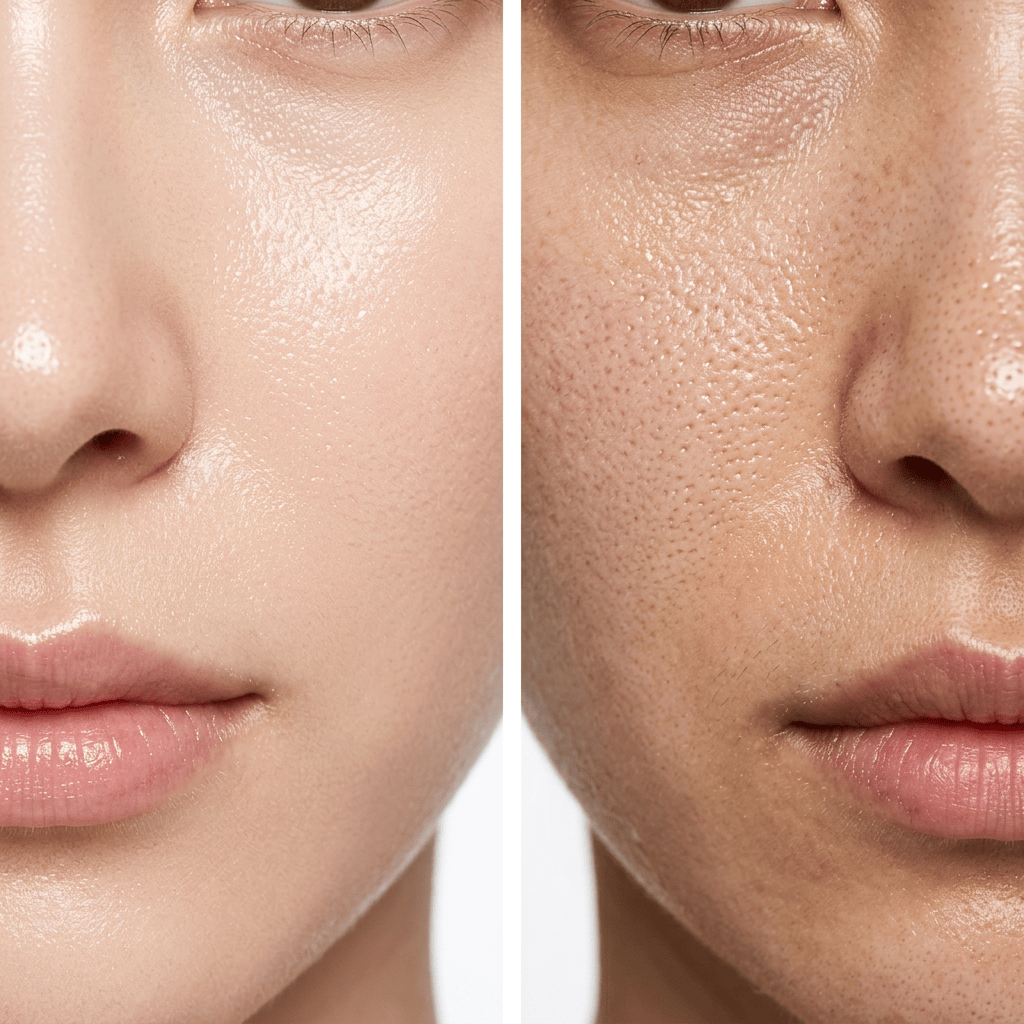
There is a very specific look associated with Korean skincare.
The skin appears:
- hydrated
- smooth
- plump
- luminous
But somehow, it doesn’t necessarily look greasy.
That difference is important.
Because hydrated skin and oily skin are not the same thing.
And understanding that distinction explains a lot about the Korean skincare approach.


Hydrated Skin vs. Oily Skin: What’s the Difference?
Let’s start here.
Hydration refers primarily to water.
Oiliness refers primarily to sebum.
Your skin can therefore be:
- oily and dehydrated
- dry and hydrated
- oily and well-hydrated
- dry and dehydrated
They are different variables.


Healthy-looking Korean skincare tends to aim for water-rich, comfortable skin with an intact barrier, rather than simply coating the surface with oil.
That’s why the finish can look luminous without necessarily looking greasy.
The Secret Is Usually Texture, Not More Moisturizer
A common approach to dryness is:
skin feels dry → apply more cream
Korean skincare often approaches the same problem differently:
skin needs hydration → add lightweight hydration first
This is one of the most important differences.
Instead of relying entirely on one thick moisturizer, hydration can be distributed across several lighter textures.
1. Korean Skincare Builds Hydration in Thin Layers
A typical hydration-focused routine might include:
toner → essence → serum → moisturizer


Notice what’s happening.
The first several layers are usually not heavy creams.
They are often:
- watery
- lightweight
- humectant-rich
- fast absorbing
This allows you to increase hydration without immediately increasing heaviness.
And you don’t necessarily need all four steps.
The principle matters more than the number of products:
build water first, then seal it appropriately.
2. Humectants Do Much of the Hydration Work
Korean skincare frequently relies on humectants.
These ingredients help attract and retain water within the outer layers of the skin.
Common examples include:
- glycerin
- hyaluronic acid
- panthenol
- beta-glucan


Because these ingredients can be incorporated into lightweight formulations, you can create a plumper appearance without necessarily using a highly oily product.
That is one reason an essence can feel almost weightless yet make the skin look noticeably more hydrated.
3. The Moisturizer Doesn’t Have to Be Heavy
This is another important K-beauty concept.
Moisturizer does not automatically mean thick cream.
Korean moisturizers come in textures such as:
- emulsions
- lotions
- gel-creams
- water creams
- lightweight barrier creams


Someone with oily or combination skin can therefore use several hydrating layers and finish with a relatively light moisturizer.
The result can be:
hydrated → but not coated.
4. Korean Skincare Often Prioritizes the Barrier
A healthy skin barrier helps reduce unnecessary water loss.
That means maintaining hydration isn’t only about continuously adding more water.
It is also about keeping the water you already have.


This is why ingredients such as:
- ceramides
- panthenol
- squalane
- centella asiatica
appear frequently in barrier-focused Korean skincare.
If the barrier functions well, the skin may remain comfortable with less reliance on extremely heavy occlusive layers.
5. Gentle Cleansing Matters More Than People Think
You cannot hydrate your way out of an unnecessarily aggressive cleansing routine.
If cleansing repeatedly leaves the skin:
- tight
- squeaky
- uncomfortable
you are beginning every routine by creating a hydration problem.

Korean skincare’s emphasis on gentle cleansing helps explain the hydrated appearance as much as the products applied afterward.
The goal is to remove:
- sunscreen
- makeup
- excess sebum
- environmental debris
without unnecessarily stripping the skin.
But What About Double Cleansing?
Double cleansing is often misunderstood.
It does not mean everyone needs to aggressively cleanse twice every morning and night.
The concept is primarily useful when you need to remove sunscreen, makeup, or other oil-soluble residue effectively.
If double cleansing makes your skin tight every night, the routine needs adjustment.
Thorough cleansing and aggressive cleansing are not the same thing.
6. Dewiness Is Created Differently From Greasiness
This is the visual distinction people notice.
Healthy-looking dewy skin reflects light relatively evenly from a smooth, hydrated surface.
Oily skin may produce more concentrated shine, particularly around areas such as:
- forehead
- nose
- chin


So when people say:
“Korean skin looks shiny, but not oily,”
what they are often noticing is the difference between luminosity across a hydrated surface and visible sebum accumulation.
7. Hydration Doesn’t Require Ten Steps
This is important.
You do not need:
- three toners
- two essences
- four serums
- a sheet mask
- a sleeping pack
every day.
A simple hydration-focused routine can be:
gentle cleanser → hydrating toner/essence → moisturizer → sunscreen
That’s enough for many people.


The famous multi-step Korean routine is a toolbox.
It is not a checklist.
8. Sunscreen Protects the Hydrated Look
UV exposure does more than cause pigmentation.
Repeated exposure contributes to:
- barrier disruption
- uneven texture
- collagen degradation
- dryness
- visible aging
Daily sunscreen therefore supports the very qualities associated with healthy, luminous skin.


And Korean sunscreens are particularly known for textures designed to integrate into skincare rather than feel like a separate heavy coating.
That makes consistent use easier.
9. The “Glass Skin” Look Is Partly About Surface Smoothness
Hydration changes the way light interacts with skin.
When the stratum corneum is well hydrated, superficial roughness can appear reduced and the surface often looks smoother and more luminous.
This contributes to the visual effect people describe as:
glass skin.
But real skin still has:
- pores
- texture
- sebaceous filaments
- fine lines
- occasional blemishes
Glass skin should therefore be understood as an aesthetic description of healthy luminosity, not literal poreless skin.
Is It Genetics?
Partly.

Genetics influence:
- pore appearance
- sebum production
- pigmentation
- skin thickness
- tendency toward certain skin conditions
So it would be misleading to attribute the appearance of Korean skin entirely to skincare.
There is also enormous variation among Korean people.
Not everyone in Korea has “glass skin.”
And not everyone following a Korean routine will develop identical skin.
Is It Lifestyle?
Lifestyle can contribute to overall skin health, but this is another area where claims can become exaggerated.
Sleep, nutrition, stress, smoking, environmental exposure, and general health all matter.
But there is no special Korean diet or lifestyle habit that magically creates glass skin.
The more reproducible lessons are much simpler:
consistent skincare + sun protection + appropriate hydration + avoiding unnecessary irritation.
How Can You Get Hydrated Skin Without Looking Greasy?
Start by changing the way you think about moisture.
Don’t immediately reach for more oil.
Try this structure:
Step 1
Gentle cleanser
Step 2
Lightweight hydration
Toner or essence with:
- glycerin
- hyaluronic acid
- panthenol
Step 3
Targeted serum if needed
Not mandatory.
Step 4
Appropriate moisturizer
Gel-cream for lighter needs.
Cream for drier skin.
Step 5
Sunscreen in the morning


Then adjust according to your skin.
If You Look Greasy After Skincare, Ask These Questions
Instead of assuming you have oily skin, ask:
Am I using too many layers?
Is my moisturizer too rich?
Is my sunscreen too heavy for this routine?
Am I layering several oil-rich products?
Do I actually need both serum and essence?
Sometimes the answer isn’t to buy an oil-control product.
It’s simply to remove one unnecessary layer.
The Biggest Mistake
Trying to create Korean-style glow by adding more oil.
That’s usually not the point.
The characteristic K-beauty glow is better understood as:
hydration + smooth surface + barrier health + controlled finishing texture
—not a layer of grease sitting on top of the skin.
Why can Korean skincare make skin look hydrated without necessarily making it oily?
Because the approach separates hydration from heaviness.
It uses:
- lightweight water-based layers
- humectants
- appropriate moisturizers
- barrier support
- gentle cleansing
- consistent sunscreen
The goal isn’t to make the skin shiny.
It’s to make it comfortable, plump, smooth, and naturally reflective.
And that is the real difference between dewy skin and oily skin.
Related Posts
- What Does “Glass Skin” Actually Mean (and Is It Realistic)?
- Why Is My Skin Still Dry After Moisturizing?
- How Do You Layer Products Without Overdoing It?
- Korean Skincare for People Who Hate Heavy Creams
- Should You Change Your Skincare Routine in Different Seasons?


Leave a Reply