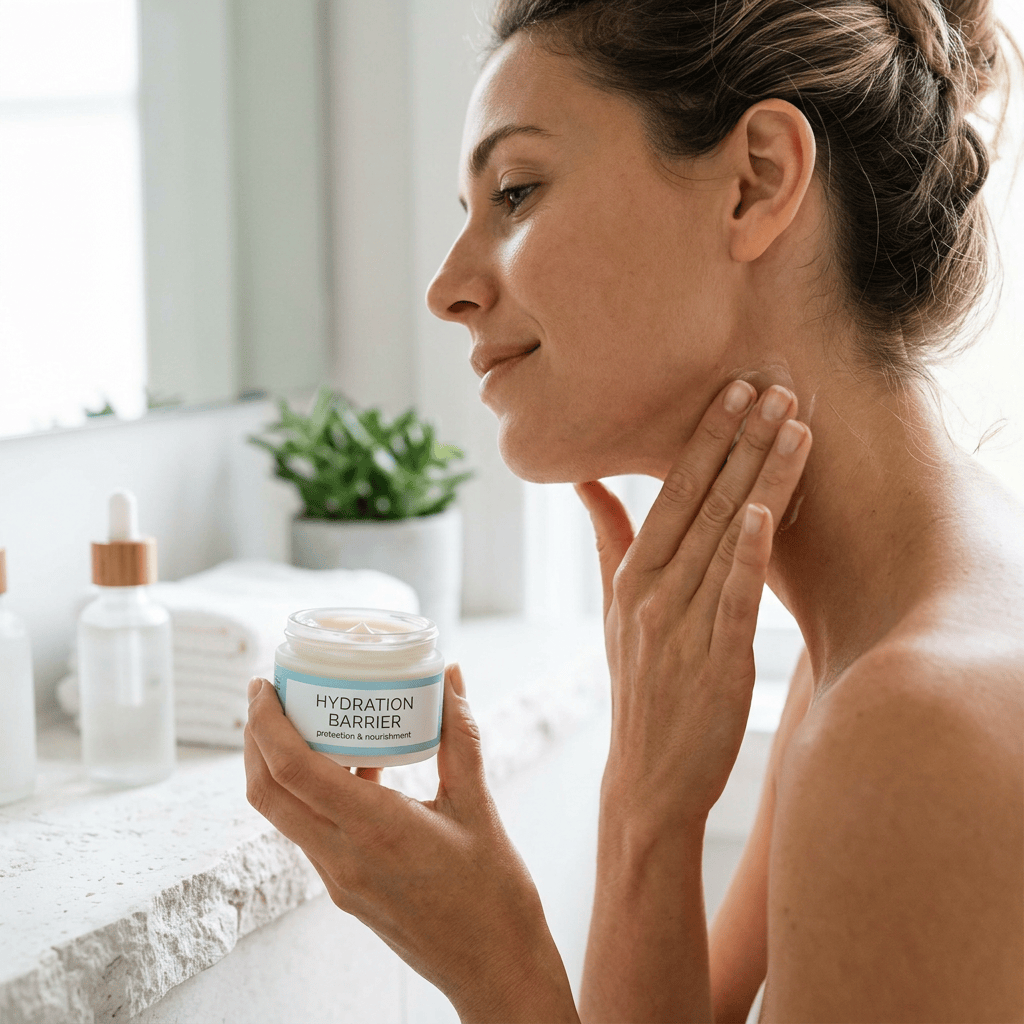
Your skin was completely fine yesterday.
Then suddenly, your cheeks look red. Your face feels warmer than usual. Your moisturizer starts to sting. Even products you’ve used comfortably for months suddenly feel wrong.
The natural reaction is to think:
“What should I put on this?”
But one of the most useful ideas in Korean skincare is to ask a different question first:
“What should I stop putting on this?”

When skin suddenly becomes irritated, the goal is not necessarily to find a stronger treatment.
The priority becomes:
calm → hydrate → repair → protect.
Why Does Skin Suddenly Become Red?
Sudden redness can have many triggers.
Sometimes it’s obvious. You tried a new exfoliating serum and woke up red the next morning.
Other times, nothing seems to have changed.
Common triggers include:
- over-exfoliation
- retinol
- strong active ingredients
- a new skincare product
- excessive cleansing
- heat
- cold wind
- sun exposure
- friction
- seasonal changes
- a weakened skin barrier
The important point is that redness itself is a symptom, not a diagnosis.


If it happens once after overdoing your skincare, the explanation may be straightforward.
If it repeatedly returns without an obvious trigger, lasts for a long time, or comes with persistent flushing, visible vessels, itching, or acne-like bumps, the cause may require more than cosmetic skincare.
The First Korean Skincare Move: Simplify
This may sound strange because Korean skincare is famous for elaborate routines.
But irritated skin is not the time for ten steps.
Imagine your normal evening routine contains:
toner → essence → vitamin C → ampoule → retinol → cream
If your skin suddenly becomes red and uncomfortable, continuing every step because it is your “routine” makes little sense.
Instead, temporarily strip things back.
5
Pause products such as:
- retinol
- AHA
- BHA
- exfoliating pads
- scrubs
- strong vitamin C
- unnecessary treatment serums
Then focus on what the skin actually needs.
Your Skin Barrier May Be the Real Problem
One reason sudden sensitivity can feel so confusing is that products you’ve always tolerated may suddenly sting.
Why?
Because the condition of the skin underneath those products has changed.
Your outer skin barrier helps keep moisture inside while reducing penetration of external irritants.
When that barrier becomes disrupted, the skin can lose water more easily and become more reactive.


This is why a moisturizer that felt completely normal last week may suddenly burn today.
It doesn’t automatically mean the moisturizer has become harmful.
Sometimes:
the product is the same, but your barrier isn’t.
Stop Exfoliating Until the Skin Feels Normal
This is particularly important if your skin looks rough.
When people see:
- flakes
- rough texture
- uneven surface
- dullness
they often reach for exfoliation.
That can be exactly the wrong response.

If the roughness comes from irritation, repeatedly removing more of the surface barrier may prolong the problem.
So remember:
Flaking does not always mean “exfoliate me.”
Sometimes it means:
“Leave me alone.”
Cooling Can Help But Don’t Put Ice Directly on Your Face
Redness is frequently accompanied by heat.
Your face feels:
- warm
- flushed
- uncomfortable
Gentle cooling can make irritated skin feel better.


Try:
- a comfortably cool compress
- a cooler room
- lukewarm cleansing water
- avoiding hot showers
- avoiding steam
- temporarily skipping saunas
What you don’t need is extreme cold.
Direct ice can itself become another physical stressor.
The objective is comfortable cooling, not freezing.
Why Is Cica Everywhere in Korean Sensitive-Skin Products?
If you’ve explored Korean skincare, you’ve probably seen the word:
CICA
everywhere.
Cica refers to Centella asiatica, a plant traditionally used in Asian medicine and now widely incorporated into Korean calming and barrier-support products.


Centella contains components including:
- madecassoside
- asiaticoside
- asiatic acid
- madecassic acid
This is why cica is commonly found in products designed for stressed or sensitive skin.
But there is a mistake to avoid.
You don’t need:
cica toner + cica essence + cica serum + cica cream + cica mask
just because your face is red.
A single simple product your skin tolerates may be far more useful.
Panthenol Is Another Ingredient Worth Knowing
Panthenol, or provitamin B5, appears frequently in Korean barrier-focused products.
It is commonly used in formulas intended to support hydration and skin comfort.
This makes it especially relevant when redness comes together with:
- dryness
- tightness
- flaking
- stinging

You don’t necessarily need a dedicated “panthenol serum.”
A moisturizer that already combines panthenol with other barrier-supportive ingredients may be enough.
Ceramides Matter When Redness Comes With Dryness
Ceramides are naturally present in the skin’s outer barrier.
They form part of the lipid structure that helps prevent excessive water loss.
So when your skin is simultaneously:
red + dry + tight + sensitive
a ceramide-focused moisturizer can make sense.
At this stage, the goal isn’t to achieve instant glass skin.
It’s to get your skin back to the point where:
washing doesn’t hurt and moisturizer doesn’t sting.
That’s progress.
Hydration Helps but More Layers Are Not Always Better
This is where Korean skincare’s lightweight hydration philosophy can be useful.
Instead of immediately applying a very thick cream, you may use a simple hydrating toner or essence first.
Look for ingredients such as:
- glycerin
- panthenol
- beta-glucan
- hyaluronic acid


Then seal that hydration with a moisturizer.
But this is not the moment for the seven-skin method just because it’s Korean.
If one layer feels good:
use one layer.
Sensitive skin does not earn extra points for tolerating more products.
What About Mugwort?
Another ingredient strongly associated with Korean calming skincare is mugwort, or Artemisia.
You’ll often see it in:
- essences
- toners
- ampoules
- masks
Mugwort-based products can be appealing when the goal is a simple calming routine.
But remember an important principle:
botanical does not automatically mean hypoallergenic.
When your skin is already highly reactive, constantly introducing new plant extracts can make it harder to identify what is actually helping.
Should You Use a Sheet Mask?
This is probably the most stereotypically Korean solution.
Red face?
Put on a cooling sheet mask.
Sometimes that feels great.
Sometimes it doesn’t.


The key is the formula inside the mask.
A sheet mask may contain:
- fragrance
- essential oils
- alcohol
- numerous botanical extracts
And the sheet itself keeps those ingredients against your skin for an extended period.
If you choose one during irritation, simple formulas are preferable.
Most importantly:
If it starts burning, remove it.
Burning is not detoxification.
It is not proof that the mask is penetrating.
Your skin is telling you something.
Avoid Friction While the Skin Is Red
Your skincare technique matters too.
During active redness, temporarily avoid:
- gua sha
- aggressive facial massage
- cleansing brushes
- scrubbing pads
- rough towels
- repeated rubbing

Use your hands gently.
Spread products without unnecessary pressure.
Pat if that feels comfortable.
Then stop touching your face.
Sunscreen Is Still Important
When skin becomes irritated, it can be tempting to skip everything—including sunscreen.
But UV exposure can add further stress to already reactive skin.


If your usual sunscreen suddenly stings, however, don’t assume you simply have to endure it.
You may need a more comfortable formulation temporarily.
You can also support protection with:
- shade
- hats
- avoiding intense midday exposure
The goal is to protect the skin without making it more irritated.
A Simple Korean Routine for Sudden Redness
Forget ten steps.
Try this instead.
Morning
Gentle cleanse or water rinse
↓
Hydrating toner or essence — optional
↓
Barrier moisturizer
↓
Sunscreen
Evening
Gentle cleanser
↓
Simple hydration — optional
↓
Barrier moisturizer

5
That’s enough.
You don’t need to actively treat every skin concern while your face is irritated.
Pigmentation can wait.
Fine lines can wait.
Exfoliation can wait.
Comfort comes first.
How Do You Know Your Skin Is Recovering?
Don’t expect perfect skin the following morning.
Instead, watch for changes in how your skin behaves.
Good signs include:
- less burning
- less heat
- reduced tightness
- less intense redness
- fewer flaky areas
- moisturizer stops stinging
- cleansing feels comfortable again


That is what recovery looks like.
Not necessarily instant glass skin.
When Can You Restart Retinol or Acids?
Wait until the skin feels normal again.
Not:
“It’s still red, but better.”
Normal.
Then restart one treatment gradually.
For example:
Retinol once → wait → observe
If everything remains comfortable, you can gradually rebuild.
Do not restart five actives simultaneously.
Otherwise, if the irritation returns, you won’t know what caused it.
What If the Redness Keeps Returning?
This is where the situation changes.
Repeated facial redness is not always a skincare-routine problem.
Persistent or recurrent redness can be associated with conditions including:
- rosacea
- contact dermatitis
- eczema
- seborrheic dermatitis
- other inflammatory skin conditions

Pay particular attention if you repeatedly experience:
- flushing
- burning
- visible facial vessels
- persistent central facial redness
- acne-like bumps
- eye irritation
At that point, endlessly buying calming cosmetics may delay identifying the actual problem.
The Biggest Misconception About Korean Skincare
Korean skincare is often reduced to one idea:
layer more products.
That’s not the useful lesson.
The useful lesson is:
adapt the routine to what your skin needs today.
Healthy skin may tolerate a complex routine.
Irritated skin may need three products.
Both can still be Korean skincare.
The Real Korean-Style Redness Strategy


Think:
REMOVE
unnecessary irritation
↓
COOL
gently
↓
HYDRATE
simply
↓
REPAIR
the barrier
↓
PROTECT
from UV and further stress
That’s the strategy.
Not:
redness = buy more products.
Bottom Line
When your skin suddenly becomes red, hot, tight, or irritated, don’t immediately search for a stronger treatment.
Start by doing less.
Pause aggressive actives.
Reduce heat and friction.
Use simple hydration.
Support the barrier with ingredients such as cica, panthenol, and ceramides if your skin tolerates them.
Protect your skin during the day.
Then give it time.
Because one of the smartest principles you can take from Korean skincare is also one of the simplest:
When your skin is overwhelmed, don’t overwhelm it with skincare.


Leave a Reply