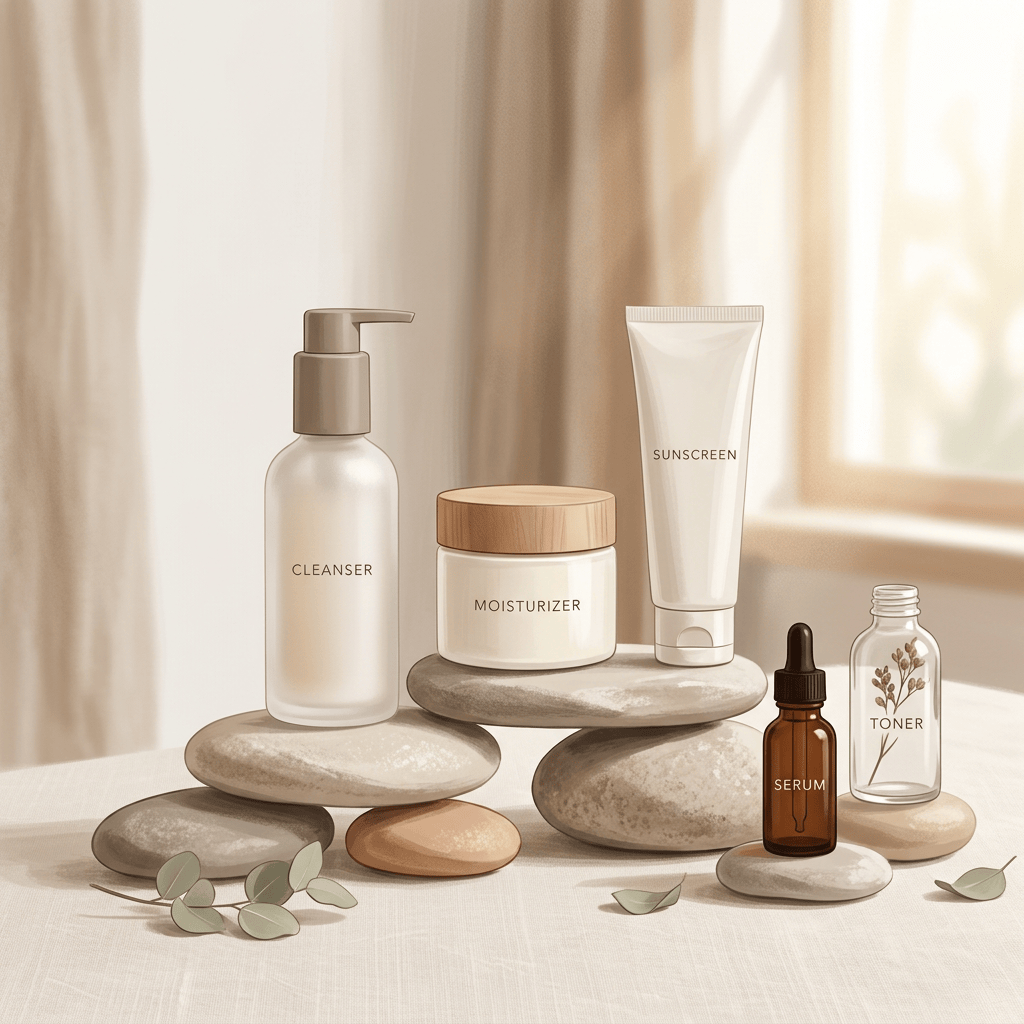
You cleanse your face.
Then comes toner.
Then essence.
Then serum.
Then ampoule.
Then cream.
And somewhere in the middle of your Korean skincare routine, you may start wondering:
Does my skin actually need all of this?
The short answer is:
No. Your skin does not inherently need toner, essence, serum, and cream as four separate steps.
Each can be useful.
But usefulness and necessity are not the same thing.


The real goal of Korean skincare isn’t to complete as many steps as possible.
It’s to give your skin what it actually needs.
Why Are There So Many Korean Skincare Steps?
Part of the confusion comes from the way Korean skincare is categorized.
Instead of asking one moisturizer to do everything, K-beauty traditionally separates different functions into different textures.
You may have:
Toner → hydration
Essence → lightweight hydration or treatment
Serum → targeted active ingredients
Cream → moisture retention and barrier support
On paper, that sounds perfectly logical.
The problem is that modern products don’t always stay neatly inside those categories.
A toner can contain niacinamide.
An essence can contain peptides.
A serum can primarily hydrate.
A cream can contain retinol.
So the labels don’t necessarily tell you what your skin is actually receiving.
What Does Toner Actually Do?
Traditional Western toners were often associated with astringency.
They were designed to remove oil and leave the skin feeling extremely clean.
Korean toners evolved quite differently.
Many modern Korean toners primarily provide lightweight hydration.


Common ingredients include:
- glycerin
- hyaluronic acid
- panthenol
- beta-glucan
- centella asiatica
So do you need toner?
Not necessarily.
If your skin feels comfortable after cleansing and your moisturizer provides enough hydration, toner may be optional.
But if your skin frequently feels tight after cleansing or benefits from lightweight hydration, toner can be a useful step.
What Does Essence Do?
Essence is probably the product category that confuses K-beauty beginners the most.
It’s usually:
thicker than toner, but lighter than serum.
Except when it isn’t.
That’s the problem.


Some essences primarily hydrate.
Others contain:
- fermented ingredients
- snail mucin
- niacinamide
- botanical extracts
- antioxidants
So an essence can function almost like a hydrating serum.
And this raises an important question.
Do You Need Both Toner and Essence?
Often?
No.
If your toner and essence are both primarily delivering lightweight hydration, their functions may overlap considerably.
For example:
Toner A
Glycerin
Hyaluronic acid
Panthenol
Essence B
Glycerin
Hyaluronic acid
Panthenol
You may enjoy using both.
But that doesn’t mean your skin requires both.

This is one of the easiest places to simplify a Korean skincare routine.
Ask:
“Does the second product give me something the first one doesn’t?”
If you can’t answer that question, you may not need both.
What About Serum?
Serum is slightly different.
Serums are usually where a routine becomes more targeted.
Instead of simply hydrating, you might choose a serum because you want to address:
- pigmentation
- acne
- fine lines
- redness
- dehydration
- uneven tone


For example:
Vitamin C serum may be chosen for antioxidant and brightening support.
Niacinamide may be chosen for pigmentation, barrier support, or oil-related concerns.
Retinoid products may be used for acne or photoaging.
Peptides may be incorporated as a gentler supportive anti-aging ingredient.
This means serum can be useful when you have a specific goal.
But even serum isn’t mandatory.
Healthy skin does not require a serum simply because Instagram routines contain one.
And Cream?
Cream—or more broadly, moisturizer—has a more fundamental role.
Your skin naturally loses water to the environment.
Moisturizers help reduce that loss while supporting the outer skin barrier.


Depending on the formula, moisturizers can contain:
Humectants
Attract and retain water.
Examples:
- glycerin
- hyaluronic acid
- urea
Emollients
Help smooth and soften the skin.
Examples:
- squalane
- fatty acids
- various lipids
Occlusives
Help reduce water evaporation.
This is why moisturizer tends to be more foundational than essence or toner.
But even here, texture matters.
Someone with oily skin in humid weather may need only a very lightweight gel-cream.
Someone with dry skin in winter may need something considerably richer.
So Which Products Does Your Skin Actually Need?
Instead of thinking in product categories, think in functions.
Your skin generally needs:
CLEAN
↓
TREAT — if necessary
↓
MOISTURIZE
↓
PROTECT

That might translate into:
Morning
Gentle cleanser or rinse
↓
Moisturizer
↓
Sunscreen
And that can be a completely reasonable skincare routine.
When Does Toner Make Sense?
Add toner when your skin would benefit from another lightweight hydration step.
For example:
Your skin feels slightly tight after cleansing, but a richer moisturizer feels too heavy.
A hydrating toner can bridge that gap.
This is particularly useful in Korean skincare because you can adjust hydration without dramatically increasing oiliness or heaviness.
When Does Essence Make Sense?
Essence becomes useful when it provides something distinct from your toner.
Maybe you want:
- snail mucin
- fermented ingredients
- additional hydration
- a particular soothing ingredient
Then essence has a clear job.
But:
“It’s the next step”
isn’t a good enough reason to use one.
When Does Serum Make Sense?
Use serum when you can finish this sentence:
“I’m using this serum because I want to address ______.”
For example:
“I want to improve uneven pigmentation.”
“I want additional hydration.”
“I want to introduce peptides.”
“I want antioxidant support.”

If you have four serums and can’t remember why you’re using two of them, your routine may have become unnecessarily complicated.
When Does Cream Make Sense?
For most people, some form of moisturizer is useful because it helps maintain hydration and support the barrier.
But “cream” does not have to mean thick.
Korean skincare offers:
- emulsions
- lotions
- gel-creams
- water creams
- barrier creams
So choose texture based on your skin rather than assuming everyone needs a heavy cream.
Dry Skin May Benefit From More Layers
This is where a longer Korean routine can genuinely make sense.
Imagine someone with very dry skin living through winter.
Their routine might be:
hydrating toner → essence → serum → barrier cream

Those layers may make their skin significantly more comfortable.
But put the exact same routine on oily skin in humid summer weather and it may feel excessive.
The routine isn’t universally good or bad.
The context changed.
Oily Skin May Need Much Less
Oily skin can still be dehydrated and still benefit from hydration.
But that doesn’t mean it needs four hydrating products.
A routine might simply be:
lightweight toner → treatment serum → gel moisturizer
That’s enough if the skin feels comfortable.
The Biggest K-Beauty Mistake: Confusing Layers With Results
This is where people get trapped.
You start with:
cleanser + moisturizer + sunscreen.
Then you discover K-beauty.
Suddenly:
toner
essence
ampoule
serum
emulsion
cream
sleeping mask
And because each product individually sounds beneficial, removing one feels like losing something important.


But skincare doesn’t work like collecting nutrients.
You don’t receive bonus points because your face encountered eight different formulas before bed.
The question is:
What does each layer contribute?
Can Too Many Hydrating Products Be Bad?
Not necessarily “bad.”
But they can become unnecessary.
Too many layers may create:
- stickiness
- pilling
- heaviness
- product incompatibility
- congestion in some users
- difficulty identifying which product causes irritation
And once several products also contain active ingredients, the routine becomes even harder to control.
More Products Also Mean More Variables
Suppose your routine contains nine products.
Your face suddenly becomes red.
Which product caused it?
Was it:
- the new toner?
- the serum?
- the fragrance in the essence?
- cumulative exfoliation?
- an ingredient interaction?
- simply too much?
The larger your routine becomes, the harder troubleshooting becomes.
This is why adding products one at a time matters.
What Is the Simplest Korean Skincare Routine That Works?
For many beginners:
Morning
Cleanse or rinse
↓
Moisturizer
↓
Sunscreen
Evening
Cleanser
↓
Targeted treatment — optional
↓
Moisturizer

That’s Korean skincare too
You don’t need ten steps to participate in K-beauty.
Then Why Are Toners and Essences So Popular?
Because optional doesn’t mean useless.
They can:
- make routines more customizable
- provide lightweight hydration
- improve the sensory experience
- deliver additional ingredients
- help dry skin without requiring one extremely heavy cream
That’s valuable.
But it is very different from saying:
everyone needs them.
How to Decide What to Remove
Try this simple test.
Pick up every product in your routine and ask:
What does this do?
If you can’t answer, reconsider it.
Is another product already doing the same thing?
If yes, you may have redundancy.
Does my skin look or feel worse without it?
If no, it may be optional.
Do I actually enjoy using it?
Enjoyment matters too.
Skincare does not have to be reduced to the absolute minimum if you genuinely enjoy the ritual.
The point is simply to know the difference between:
I like using this
and
my skin requires this.
A Better Way to Think About the Korean Routine
Don’t think:
toner → essence → serum → cream
Think:
HYDRATE
↓
TREAT
↓
SEAL
↓
PROTECT

Sometimes hydration requires one product.
Sometimes three.
Sometimes treatment isn’t necessary at all.
Your routine can change according to:
- season
- humidity
- skin condition
- age
- sensitivity
- current concerns
That’s much closer to the useful philosophy behind Korean skincare.
Does your skin really need toner, essence, serum, and cream?
No—not simply because those categories exist.
Toner can add lightweight hydration.
Essence can provide hydration or additional treatment.
Serum can target a specific concern.
Cream can help retain moisture and support the skin barrier.
All four can be useful.
But you don’t automatically need all four.
The better question is:
What does my skin need—and which product can do that job most efficiently?
Because the best Korean skincare routine isn’t the one with the most steps.
It’s the one where every step has a reason to be there.
Related Posts
- The Truth About the 10-Step Korean Skincare Routine
- How Do You Layer Products Without Overdoing It?
- What Is the Simplest Routine That Actually Works?
- Is It Better to Use Fewer Products?
- How Do You Choose the Right Korean Products for Your Skin?


Leave a Reply