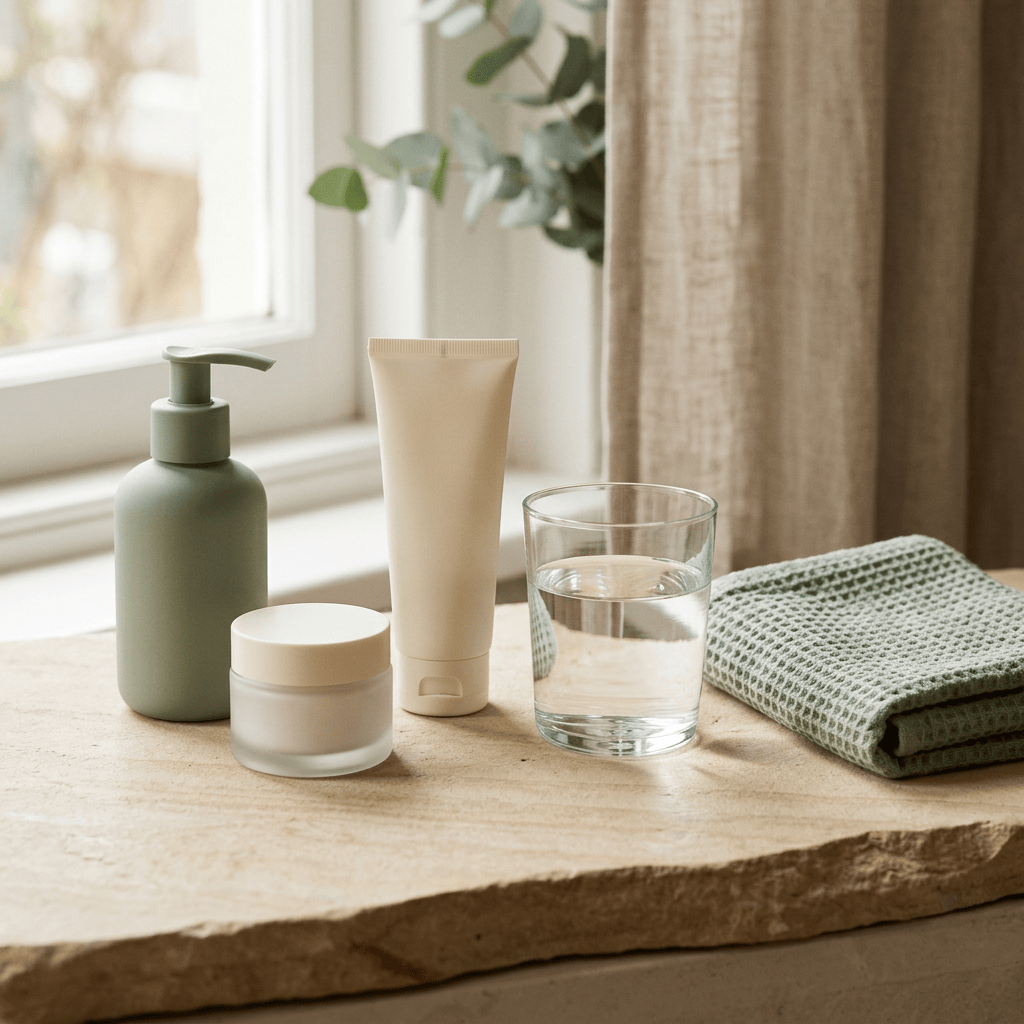
“Glass skin” has become one of the most recognizable beauty ideals associated with Korean skincare.
Smooth. Clear. Hydrated. Almost translucent.
The skin looks so luminous that light seems to reflect effortlessly across its surface.
It’s a beautiful aesthetic—and one that has inspired millions of people to explore K-beauty.
But there’s something important that often gets lost in the excitement surrounding glass skin.
Glass skin is a beauty aesthetic. It is not a medical definition of healthy skin.
And it shouldn’t necessarily be everyone’s skincare goal.
Your skin can be healthy without being reflective.
It can have visible pores, freckles, fine lines, uneven pigmentation, and natural texture.
In fact, trying too hard to achieve a perfectly smooth, glass-like appearance can sometimes lead people to damage the healthy skin they already have.
What Does Glass Skin Actually Mean?
In Korean beauty, glass skin generally describes a complexion that appears exceptionally hydrated, smooth, clear, and luminous.
The characteristic glow comes partly from the way light reflects off the skin’s surface.
When the outer skin layers are adequately hydrated, fine surface irregularities can become less noticeable, creating a smoother and more radiant appearance.
But somewhere between Korean beauty culture and global social media, the definition became increasingly unrealistic.
Glass skin began to suggest something closer to:
No pores. No wrinkles. No pigmentation. No blemishes. No texture.
That’s where the problem begins.
Because normal human skin doesn’t look like that.
Real Skin Has Pores—and That’s Completely Normal
Pores are not imperfections that need to be eliminated.
They’re part of the skin’s normal anatomy.
Hair follicles and sebaceous glands remain present regardless of how many skincare products you apply.
The visibility of pores depends on several factors:
- Genetics
- Sebum production
- Skin structure
- Age
- Acne history
- Sun damage
Certain skincare ingredients and professional treatments can improve the appearance of enlarged pores.
However, there is a significant difference between making pores less noticeable and eliminating them entirely.
Healthy skin does not need to be poreless.
And a complexion with visible pores can still be exceptionally healthy.
Different Skin Types Produce Different Kinds of Glow
Imagine two people following exactly the same Korean skincare routine.
One has naturally dry skin.
The other has oily skin.
The person with dry skin may benefit from several layers of lightweight hydration before applying moisturizer.
The person with oily skin may find the same routine unnecessarily heavy.
The result?
One person’s skin looks comfortably luminous.
The other’s looks excessively shiny.
This illustrates one of the most important principles of skincare:
The same routine does not produce the same result on every face.
Your skin’s natural oil production, hydration levels, and barrier function determine how products behave.
For someone with oily skin, achieving a healthy, balanced complexion may involve reducing excess shine rather than deliberately increasing it.
And that’s perfectly reasonable.
Oily Skin Doesn’t Need to Look Dewy
Korean skincare is often associated with glowing skin.
But glow is not a requirement for healthy skin.
People with naturally oily complexions may prefer lightweight moisturizers, gel-based formulations, and products that leave a natural or semi-matte finish.
Trying to achieve maximum luminosity through repeated layering may create unnecessary heaviness.
It can also make the routine uncomfortable or difficult to maintain.
A person who prefers a matte complexion isn’t taking worse care of their skin.
They’re simply choosing a different aesthetic.
Dewiness is a cosmetic preference—not a biological indicator of skin health.
Acne-Prone Skin May Have More Important Priorities
For someone dealing with inflammatory acne, the immediate skincare priorities are often very different from achieving glass skin.
The focus may be on reducing breakouts, controlling inflammation, preventing post-inflammatory pigmentation, and maintaining the skin barrier.
Trying to achieve maximum luminosity through multiple oils, essences, ampoules, and creams can unnecessarily complicate acne management.
Someone can have occasional blemishes and still maintain a healthy skin barrier.
Likewise, acne scars or post-inflammatory marks do not automatically indicate poor skincare habits.
A successful acne routine should be judged primarily by improvements in the underlying condition—not by whether the skin resembles a filtered beauty advertisement.
Sensitive Skin Can Actually Become Worse When Chasing Glass Skin
This is one of the most important reasons glass skin should not be a universal goal.
Imagine noticing some roughness on your cheeks.
You start exfoliating.
The texture doesn’t disappear immediately, so you exfoliate more frequently.
Then you introduce a strong vitamin C serum to improve pigmentation.
Next comes retinol for fine lines.
Finally, you add another exfoliating toner because your pores still look visible.
Eventually, your skin becomes red, tight, and reactive.
Even your usual moisturizer starts stinging.
At this point, the original concern is no longer the main problem.
The skin barrier may now be irritated.
Perfect-looking skin and healthy skin are not always the same pursuit.
If achieving temporary smoothness requires repeatedly irritating the skin, the routine has become counterproductive.
For sensitive skin, maintaining comfort and stability is often a much more meaningful objective.
Age Changes What Healthy Skin Looks Like
Glass skin imagery is frequently associated with youthful complexions.
That’s understandable.
Younger skin often has greater dermal support, different hydration characteristics, and fewer accumulated signs of environmental damage.
But aging is a normal biological process.
Over time, collagen organization changes, elasticity decreases, and facial structures gradually evolve.
Fine lines develop.
Pigmentation may become more noticeable.
Skin texture changes.
None of these changes automatically means the skin is unhealthy.
A 55-year-old face does not need to resemble a 22-year-old face to demonstrate excellent skin health.
In fact, a mature complexion with natural expression lines, comfortable hydration, and an intact skin barrier may be considerably healthier than younger skin subjected to constant aggressive treatments.
The objective of anti-aging skincare should not necessarily be to eliminate every visible sign of time.
A more realistic goal is to maintain skin quality, comfort, and resilience throughout the aging process.
Genetics Matter More Than Skincare Marketing Suggests
Two people can use exactly the same skincare products and still have completely different complexions.
The same cleanser.
The same serum.
The same moisturizer.
The same sunscreen.
Yet their pores, pigmentation, oil production, and overall skin texture may remain noticeably different.
Why?
Because skincare cannot override every genetically determined characteristic.
Genetics influence:
- Sebum production
- Pore appearance
- Skin thickness
- Pigmentation tendencies
- Acne susceptibility
- Vascular reactivity
- Age-related skin changes
A good skincare routine can help optimize your individual skin condition.
It cannot transform your skin into someone else’s biology.
Glass Skin Doesn’t Require Ten Steps
One of the biggest misconceptions surrounding Korean skincare is that achieving beautiful skin requires an elaborate routine.
Toner.
Essence.
Serum.
Ampoule.
Sheet mask.
Eye cream.
Moisturizer.
Sleeping pack.
But adding more products does not automatically produce healthier skin.
For some people, a routine consisting of a cleanser, moisturizer, and sunscreen may be entirely sufficient.
Others may benefit from adding a targeted serum or lightweight hydrating essence.
Someone with very dry skin may genuinely prefer several layers.
The important distinction is that each product should serve a purpose.
More skincare steps do not automatically mean better skincare.
Social Media Glass Skin Isn’t Always Real-Life Skin
This is another important consideration.
The glass skin frequently showcased on social media may involve professional lighting, makeup, camera settings, and digital editing.
Even without filters, lighting alone can dramatically change how skin texture appears.
Soft frontal lighting minimizes shadows around pores and fine lines.
Directional lighting can make those same features considerably more visible.
The same person’s complexion can look almost poreless in one photograph and visibly textured in another.
Neither image necessarily provides an accurate assessment of skin health.
This is why comparing your face in a bathroom mirror with professionally photographed beauty content can create unrealistic expectations.
Sometimes Glass Skin Is Partly Makeup
Another detail often overlooked is that the glass-skin aesthetic isn’t always created entirely through skincare.
Makeup can enhance the appearance through luminous primers, hydrating foundations, cream highlighters, and strategically placed reflective products.
This isn’t inherently misleading.
Makeup is designed to change how the skin appears.
However, it is useful to distinguish between a skincare outcome and a finished beauty aesthetic.
A highly reflective complexion does not necessarily indicate superior hydration or barrier function.
Sometimes it simply reflects the products applied to the surface.
What Should Your Skincare Goal Be Instead?
A more useful goal is healthy skin that functions comfortably.
That means skin that maintains hydration, tolerates an appropriate routine, and isn’t repeatedly irritated by unnecessary treatments.
Healthy skin should also be protected against avoidable environmental damage, particularly ultraviolet radiation.
Notice what this definition does not require.
Invisible pores.
Perfectly even pigmentation.
A permanently glossy finish.
Complete absence of wrinkles.
Healthy skin can have freckles, expression lines, acne scars, and visible texture.
These characteristics do not automatically indicate that something needs to be corrected.
Can You Still Pursue Glass Skin?
Of course.
There is nothing wrong with enjoying the appearance of luminous, hydrated skin.
The important distinction is between a personal aesthetic preference and a universal biological standard.
If you enjoy a dewy finish, you can build a routine around hydration and appropriate moisturization.
But that routine should still respect your skin’s natural characteristics.
A sensible approach includes gentle cleansing, adequate hydration, appropriate treatment ingredients, and consistent sun protection.
Avoid introducing unnecessary products simply to increase surface shine.
And if your skin becomes irritated, simplify the routine rather than continuing to chase the same appearance.
The Most Important Korean Skincare Principle Is Flexibility
Korean skincare is often presented internationally as a fixed sequence of products.
But the most useful aspect of the philosophy is its adaptability.
Your skin’s needs change.
Humidity changes.
Temperature changes.
Hormones change.
Skin sensitivity changes.
And your priorities may change as you get older.
Some days your skin benefits from additional hydration.
Other days it needs fewer products.
Sometimes an active treatment is appropriate.
Sometimes the most sensible approach is to temporarily stop using it.
The best skincare routine is not necessarily the longest or most expensive.
It’s the one that consistently meets your skin’s needs without creating unnecessary problems.
Bottom Line
Why isn’t glass skin the goal for everyone?
Because human skin is biologically diverse.
Genetics, age, skin type, environment, pigmentation, sensitivity, and individual preferences all influence what healthy skin looks like.
Glass skin can be a beautiful aesthetic.
But it is not a medical benchmark.
And it certainly isn’t proof that someone is taking better care of their skin.
A better goal is much simpler:
Skin that is comfortable, resilient, protected, and healthy for you.
If that skin happens to look like glass, wonderful.
If it doesn’t, that doesn’t mean your skincare routine is failing.
Because the real purpose of skincare isn’t to make every face look the same.
It’s to help your skin become the healthiest version of itself.
Related Posts
- What Does “Glass Skin” Actually Mean (and Is It Realistic)?
- Why Does Korean Skin Look So Hydrated Without Looking Oily?
- Does Your Skin Really Need Toner, Essence, Serum, and Cream?
- How Do You Layer Products Without Overdoing It?
- The Truth About the 10-Step Korean Skincare Routine


Leave a Reply